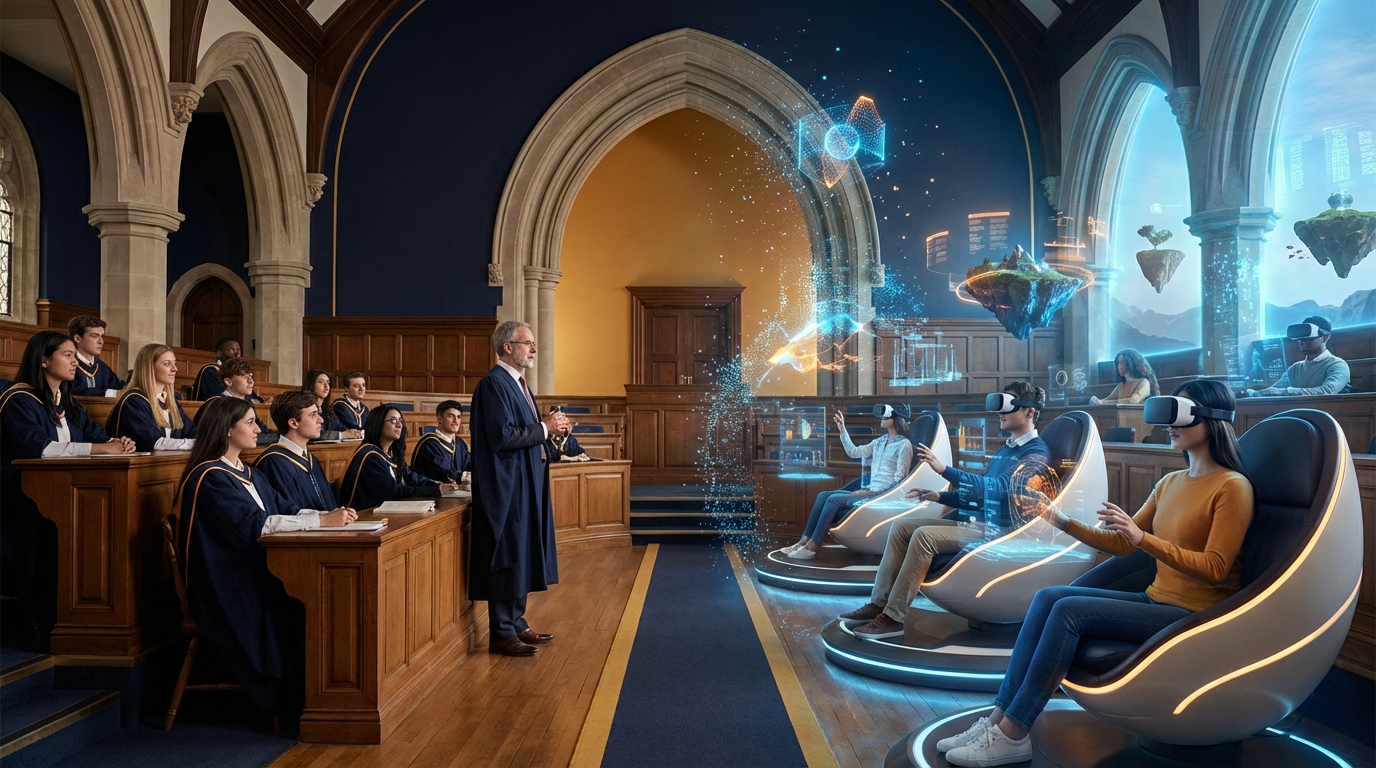
Executive education is undergoing a profound paradigm shift. As the global wave of fintech disrupts existing regulatory frameworks, industry leaders no longer need textbook-style knowledge updates but rather cross-disciplinary insights and strategic vision that can be immediately applied to real-world decision-making. In 2019, I was appointed Academic Director of the Fintech and Regulatory Innovation Program (FTRI), jointly developed by the University of Cambridge and Zhejiang University — a direct response to this emerging need for a new approach to fintech regulation.
I. The Crisis and Reinvention of Executive Education
Harvard Business Review noted in a landmark article that corporations invest billions of dollars annually in executive education, yet the returns are often disappointing. The core reason is that traditional business schools excel at teaching hard skills (financial analysis, strategic frameworks) but fall short in cultivating the soft skills that leaders truly need — cross-cultural communication, global perspective, and decision-making under uncertainty.[1]
Moldoveanu and Narayandas further warned in Harvard Business Review that the future of executive education belongs to the "Personal Learning Cloud" — a learning ecosystem that integrates online courses, interactive platforms, and digital tools to deliver personalized, socialized, contextualized, and trackable learning experiences.[2] This implies that executive education must shift from "professor-led" to "learner-centered," and from "knowledge transfer" to "capability building."
However, theoretical calls are easy to make; practical implementation is far more challenging. How can a single program simultaneously achieve a global perspective, cutting-edge content, and immediately applicable practical value? This is precisely the question that the FTRI program sought to answer.
II. FTRI: A Cross-Border Co-Creation Experiment in Education
The rapid development of fintech has posed unprecedented challenges to global regulatory systems. Digital payments, blockchain, crypto assets, P2P lending, insurtech — these innovations create enormous commercial value while simultaneously generating regulatory vacuums and systemic risks. Regulators worldwide must both encourage innovation and prevent risk. This "promote and protect" dilemma is precisely the critical domain where executive education can deliver value.
The Cambridge Centre for Alternative Finance (CCAF) at Cambridge Judge Business School is a globally leading fintech research institution whose research directly influences policy-making across nations.[3] Meanwhile, Zhejiang University International Business School (ZIBS) is deeply embedded in the frontline of China's fintech innovation — Hangzhou, the headquarters of fintech giants such as Alipay and Ant Group.
What makes FTRI distinctive is that it is not a unilateral export from either party, but a genuine co-creation. Cambridge brought rigorous academic research frameworks and a global comparative regulatory perspective; ZJU/ZIBS contributed firsthand observations of China's fintech industry and Asia-Pacific market insights. This combination of "academic depth x industry breadth" embodies exactly the global partnership model advocated by MIT Sloan Management Review — through complementary cross-border collaboration, creating educational value that neither party could achieve independently.[4]
III. Curriculum Design: From "Knowing" to "Doing"
As FTRI's Academic Director, I adhered to one principle in curriculum design: every theoretical module must correspond to a practical scenario, and every learning experience must produce an actionable plan.[5]
The eight-week intensive online FTRI program adopted a three-tier blended learning architecture:
- Self-paced Learning — Participants flexibly digest core theoretical modules on their own schedule, covering topics such as the fintech ecosystem landscape, regulatory sandbox mechanisms, digital payment frameworks, and crypto asset governance.
- Live Interactive Sessions — Co-facilitated by professors from Cambridge and Zhejiang University, with industry leaders invited to participate in case analyses and roundtable discussions for deep learning.
- On-site Workshop — An intensive multi-day in-person workshop in Hangzhou, including corporate site visits, policy simulations, and strategic proposal development.
This design echoes the new leadership development trends described in Harvard Business Review: learning is no longer confined within the four walls of a classroom but is integrated into the workflow, practiced repeatedly in real problem contexts.[2]
IV. Participant Composition: From Mastercard to Invesco
The inaugural cohort of Chinese participants comprised 34 senior executives from organizations including Mastercard, Invesco Asia-Pacific, and top Chinese financial institutions.[5] These participants were not typical "classroom students" — they were decision-makers at their respective organizations, directly facing the pressures of fintech transformation.
I deliberately emphasized the value of peer learning in the curriculum design. In FTRI discussion sessions, a chief compliance officer from a traditional bank and a CTO from a fintech startup sat at the same table, sharing their respective challenges and insights — the value of such dialogue often surpassed any professor's lecture. Research by the World Economic Forum also indicates that cross-sector collaboration and knowledge sharing represent the critical pathway to finding balanced solutions to the regulatory challenges posed by fintech.[6]
V. My Philosophy of Executive Education: Three Commitments
Over a decade, from Cambridge to Zhejiang University, from MBA classrooms to executive education programs, I have gradually formed three core beliefs about executive education:
Commitment One: Globalization Is Not a Slogan — It Is Curricular DNA
Truly global education does not mean simply adding the word "Global" to a program title. It means embedding cross-cultural perspectives and comparative methodologies into every aspect of the curriculum. FTRI chose the Cambridge-ZJU collaboration model precisely because these two institutions represent different approaches to fintech governance in Europe and Asia — the former emphasizing a principles-based regulatory philosophy, the latter demonstrating technology-driven innovation dynamism. The essence of the global partnerships emphasized by MIT Sloan lies precisely in this — complementary collaboration generates more innovation than homogeneous alliances.[4]
Commitment Two: Professors Are Not Answer Providers but Question Guides
In the executive education setting, participants' practical experience is often richer than that of the professors. My role is not to tell them the "correct answer" but rather, through carefully designed question frameworks, to guide them in extracting insights from their own experience and gaining inspiration from peer exchange. This is consistent with the case method long championed by Harvard Business School, but goes further — we not only discuss past cases but require participants to immediately apply discussion outcomes to the real challenges facing their own organizations.
Commitment Three: Learning Does Not End When the Program Ends
The most important outcome of a successful executive education program is not a certificate of completion, but a continuously functioning professional community. After the FTRI program concluded, participants continued to stay connected through Cambridge's research network and ZIBS's industry platform, forming a knowledge community that transcends institutional boundaries. This concept of a "lifelong learning ecosystem" is precisely the future learning direction advocated by MIT Sloan Management Review.[7]
VI. Implications: The Next Decade of Executive Education
The FTRI experience offers several concrete implications for global executive education:
First, cross-border co-creation outperforms unilateral export. In the past, executive education was often a process of Western elite business schools "exporting" knowledge to emerging markets. The FTRI model demonstrates that when two institutions with complementary strengths jointly design and jointly deliver a program as equals, the resulting educational value far exceeds either party's unilateral efforts.
Second, cutting-edge topics require cutting-edge pedagogy. When course content itself is rapidly evolving (such as fintech regulation), traditional lecture-based teaching proves inadequate. Methodological innovations — blended learning, real-time case studies, policy simulations — are equally important as the content's cutting-edge nature.
Third, the true competitive advantage of executive education lies in the "ecosystem." Harvard Business Review notes that future leadership development will shift from isolated training events to continuous processes embedded in the workflow.[2] This means that business schools need to build not merely a single program, but a complete ecosystem encompassing academic research, industry connections, alumni networks, and lifelong learning resources.
Standing at the intersection of Cambridge and Zhejiang University, I am deeply convinced that executive education is at a historic turning point. Technological evolution, geopolitical realignment, and industrial transformation all demand that educators respond to this era's educational needs with a more open mindset, bolder experimental spirit, and more rigorous academic foundations. FTRI is just the beginning, but the direction it explores — global co-creation, cross-disciplinary integration, and learner-centricity — will, I believe, be the future of executive education.
References
- Lorange, P. & Thomas, H. (2016). Strategic Transformation in Higher Education. In: Rethinking the MBA. Harvard Business Publishing. hbr.org
- Moldoveanu, M. & Narayandas, D. (2019). The Future of Leadership Development. Harvard Business Review, 97(2), 40–48. hbr.org
- Cambridge Judge Business School. Cambridge Centre for Alternative Finance (CCAF). jbs.cam.ac.uk
- MIT Sloan. Global Programs — Partnerships. mitsloan.mit.edu
- ZIBS, Zhejiang University. Fintech Regulatory Innovation Program (FTRI). zibs.zju.edu.cn
- World Economic Forum. (2022). The metaverse: Here's how it can impact education. weforum.org
- MIT Sloan Management Review. The Future of Workplace Learning. sloanreview.mit.edu