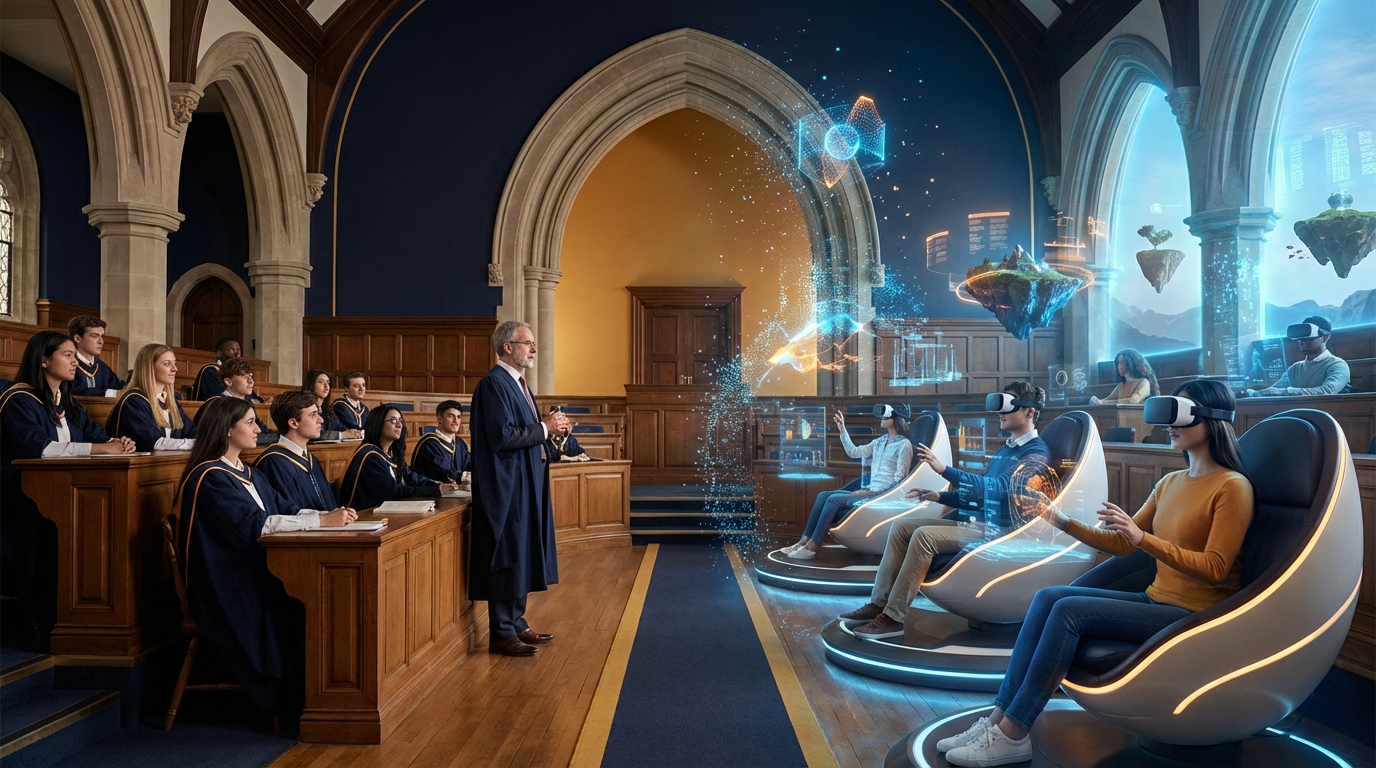
When we discuss the future of higher education, the question is not whether technology can replace the classroom, but rather: once the boundaries of physical space are broken, what new forms will knowledge delivery, faculty-student interaction, and industry-academia collaboration take? In 2022, the Metaverse Campus I led the construction of at Zhejiang University International Business School (ZIBS) was a concrete response to this very proposition.
1. Why the Metaverse? An Educator's Reflection
Over the past decade, global higher education has been experiencing a quiet structural crisis. Traditional lecture-based instruction has become increasingly inadequate for meeting the learning needs of the digital native generation; and the COVID-19 pandemic further exposed the fragility of the physical campus model in a globalized context — when borders closed and flights were grounded, the promise of internationalized education evaporated almost overnight.[1]
Yet crisis also breeds reflection. Harvard Business Review noted that the pandemic's push for universities to move to online teaching was a change that was "long overdue" — it forced educators to re-examine what constitutes the core value of education, and what role technology should truly play.[2] Research from MIT Sloan Management Review further indicated that future learning will no longer be a one-time campus experience, but a continuous process integrated into work and life (learning in the flow of work), where learners need more immersive, contextualized, and trackable learning experiences.[3]
It was against this backdrop that I began to consider: could metaverse technology be used to construct an entirely new paradigm for business education — one that preserves the warmth and depth of faculty-student interaction found in physical classrooms, while breaking through geographical constraints, enabling truly seamless sharing of the world's best academic resources?
2. From Zero to One: The Birth of the ZIBS Metaverse Campus
On April 27, 2022, Zhejiang University International Business School officially launched the Metaverse Campus, becoming one of the first institutions worldwide to systematically integrate metaverse technology into higher business education.[4] I was appointed as Founding Director of the Metaverse Campus, responsible for overseeing the entire process from conceptual design to implementation.
This was not a technology showcase. From the outset, we insisted on letting educational objectives drive technology design, not the other way around. McKinsey estimated in its 2022 research that the potential market for the metaverse in education could reach $270 billion, but the real challenge lies not in the scale of investment, but in how to translate technological possibilities into actual pedagogical impact.[5]
The Metaverse Campus was built around three core pillars:
- Immersive Learning — Leveraging virtual reality technology to create global classrooms that transcend geographical constraints, enabling students in different countries to engage in real-time interaction, case discussions, and collaborative learning within the same virtual space.
- Metaverse Exhibition — Constructing virtual industry exhibition spaces that seamlessly connect classroom learning with business practice, allowing students to gain a deep understanding of industry dynamics in an immersive environment.
- Innovation and Entrepreneurship Roadshow Platform — Building a new arena for student startup teams and industry investors, where creative proposals can be presented in a more intuitive and compelling manner within a blended physical-virtual environment.[6]
3. My Educational Philosophy: Technology as Instrument, Education as Purpose
Throughout the process of leading the Metaverse Campus, I consistently upheld one core belief: technology is the means; education is the end. Any introduction of technology that fails to substantively improve learning outcomes, deepen faculty-student interaction, or expand the boundaries of cognition loses its raison d'être in an educational context.
This philosophy is rooted in insights gained from years of cross-national teaching. My experience teaching at the University of Cambridge in the UK, Zhejiang University in China, and Nagoya University in Japan has given me a profound understanding: good education is never a one-way transmission of knowledge, but a two-way collision of ideas. As Harvard Business Review has emphasized, future leadership development requires "personalized, socialized, and contextualized" learning experiences — learners must not only absorb knowledge but also practice, reflect, and iterate in real or simulated contexts.[3]
Metaverse technology provides an unprecedented pathway for realizing this educational ideal. Porter and Heppelmann pointed out in Harvard Business Review that augmented reality technology is fundamentally transforming how humans perceive and interact, with especially enormous potential for applications in training and education.[7] When students can "walk into" a fintech company's risk management center in a virtual space, or "experience firsthand" a cross-border M&A due diligence process, the gap between classroom and practice is no longer insurmountable.
4. Global Launch: Collective Endorsement from the Academic Community
The launch ceremony of the Metaverse Campus attracted extensive international attention and endorsement from the academic community. Han Seung-soo, President of the 56th Session of the United Nations General Assembly, He Lianzhen, Vice President of Zhejiang University, Professor Ben Shenglin, Dean of ZIBS, and Cai Jin, Co-CEO of Sing Tao News Corporation, attended the launch ceremony and delivered remarks.[4]
Even more noteworthy was the participation of deans from top global business schools — Giuliano Noci, Vice Rector of Politecnico di Milano; Fiona Devine, Dean of the Alliance Manchester Business School; John Finch, Dean of the Adam Smith Business School at the University of Glasgow; and Jose Martinez-Sierra, Dean of the UPF Barcelona School of Management. The attendance of these academic leaders from Europe's premier business schools represented not merely ceremonial support, but the international academic community's endorsement of and expectations for the integration of metaverse technology into higher education.
The World Economic Forum noted in its 2022 report that "Metaversities" are emerging as a new trend in global higher education, with institutions such as the Hong Kong University of Science and Technology and VictoryXR investing in the construction of virtual campuses.[8] What set the ZIBS Metaverse Campus apart, however, was that it did not merely construct a virtual space — it designed a complete pedagogy, from curriculum design and faculty-student interaction to learning assessment, forming an organic educational ecosystem.
5. Reflections and Outlook: Educational Imagination Beyond Technology
Looking back on the journey of building the Metaverse Campus, my deepest takeaway is this: the core of educational innovation has never been about the technology itself, but about how educators understand the essence of learning, and how they harness technology to serve that essence.
Harvard Business Review once called for "a Renaissance in business education," urging business schools to cultivate not only analytical capability but also creativity, empathy, and a global perspective.[9] I could not agree more. The true value of the Metaverse Campus lies not in how cutting-edge its technology is, but in the space it offers educators to reimagine what education can be — where an MBA student in Hangzhou can explore the future of fintech alongside a professor from Cambridge, an entrepreneur from Bangkok, and a designer from Milan within the same virtual space. This kind of learning experience, transcending culture and geography, is something traditional classrooms can scarcely replicate.
Looking ahead, I believe the role of immersive technology in higher education will continue to deepen. But I also constantly remind myself and my colleagues: technology evolves far faster than educational philosophy. As educators, our responsibility is not merely to chase the latest technological wave, but to safeguard the original aspiration of education — to cultivate future leaders with independent thinking, a global perspective, and a humanistic concern. This is the starting point of the Metaverse Campus, and it is my enduring pursuit as an educator.
References
- World Economic Forum. (2022). The metaverse: Here's how it can impact education. weforum.org
- Gallagher, S. & Palmer, J. (2020). The Pandemic Pushed Universities Online. The Change Was Long Overdue. Harvard Business Review. hbr.org
- Moldoveanu, M. & Narayandas, D. (2019). The Future of Leadership Development. Harvard Business Review, 97(2), 40–48. hbr.org
- BusinessWire. (2022). New Adventure in the ZIBS Metaverse Campus. businesswire.com
- McKinsey & Company. (2022). Value creation in the metaverse. mckinsey.com
- China Daily. (2022). Cultivating Future Education: Zhejiang University International Business School (ZIBS) to Launch Metaverse Campus on April 27. chinadaily.com.cn
- Porter, M. E. & Heppelmann, J. E. (2017). Why Every Organization Needs an Augmented Reality Strategy. Harvard Business Review, 95(6), 46–57. hbr.org
- World Economic Forum. (2022). Metaversities: 5 challenges of studying in the metaverse. weforum.org
- Segran, E. (2014). The Renaissance We Need in Business Education. Harvard Business Review. hbr.org